

Most freelancers know they should track their time. Most don’t do it consistently.
The reason is usually the same: it feels like overhead. Another thing to remember, another system to maintain, another app open on the desktop. The work is already done — why document it?
Here’s why: the freelancers who don’t track their time aren’t just losing billing accuracy. They’re flying blind on every business decision they make. Which clients are worth taking? Are their rates too low? Why are they always busy but never getting ahead? Time data answers all of it.
This is how to build the habit before it starts costing you.

Why Time Tracking Feels Hard (And Why That Feeling Is Wrong)
The friction around time tracking is almost always psychological, not practical. Starting a timer takes two seconds. The real barrier is the feeling that tracking implies distrust, or that it’s something agencies do, not independent freelancers.
Neither is true. Tracking your time isn’t about proving yourself to anyone. It’s about knowing your own business. A freelancer who doesn’t track time is like a business owner who doesn’t look at their bank account. The money might be fine. Or it might not be. You genuinely don’t know.
The other common objection is “I’ll do it later.” Reconstructing your hours at the end of the day from memory is not time tracking. It’s guessing. Studies on time perception consistently show that people underestimate how long tasks take, particularly for knowledge work. When you reconstruct hours, you round down. Every time.
Reconstructing your hours at the end of the day is not time tracking. It’s guessing … and you always guess low.
How to Track Time Effectively
The system that works is the simplest one you’ll actually use. Here are the principles:
Track at the task level, not the project level. “Client work — 3 hours” tells you almost nothing. “Homepage copy revision — 1.5 hours” tells you exactly what that task cost, which helps you estimate it next time. Task-level tracking also feeds directly into your invoice line items, so your billing writes itself.
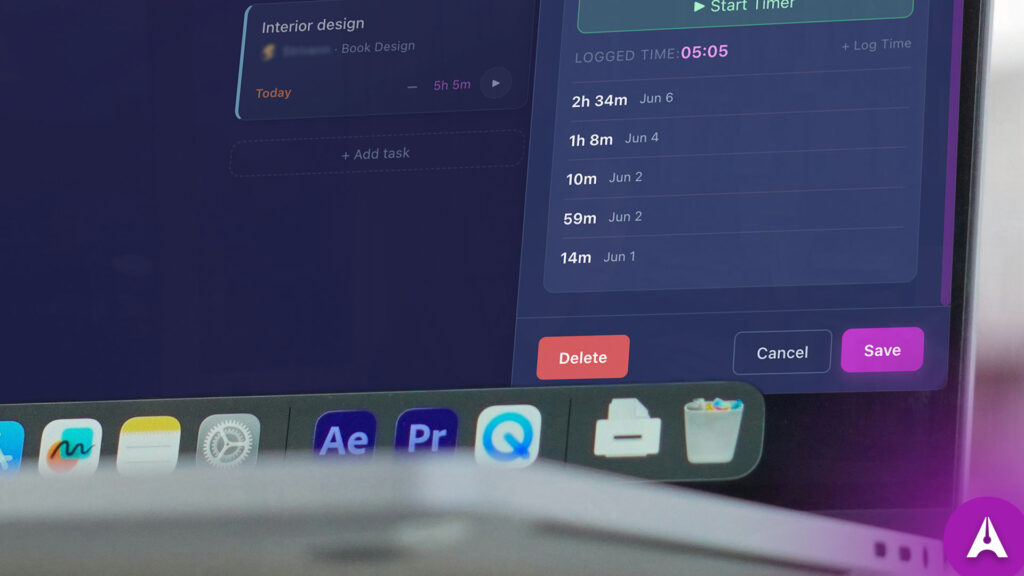
Start the timer before you start the work. Not after. Not when you remember. Before. Make it part of the ritual of opening a task: you sit down, you start the timer, you work. The moment you try to backfill time, accuracy degrades.
Track non-billable time too. Client calls, internal admin, time spent context-switching between projects — none of this gets billed, but all of it costs you. Knowing what percentage of your working day is non-billable is essential data for setting sustainable rates.
Don’t round or adjust your tracked time before invoicing. Bill what you tracked. If you’re worried the number looks high, the right move is to have a conversation with your client about scope, not to silently discount your own work. Consistent, accurate time data builds trust over time.
What Counts as Billable Time
New freelancers often undercharge because they’re uncertain about what they can legitimately track. A useful test: would this time exist if not for this client engagement?
Track these:
- Direct project work
- Client meetings and calls (including prep and follow-up notes)
- Revisions and feedback rounds within agreed scope
- Project-specific research or asset gathering
- Email threads requiring substantive thought or decisions
Don’t track these:
- Time spent learning skills you didn’t already have
- Rework caused by your own errors
- General business admin (invoicing, bookkeeping, prospecting)
- Speculative work done before the project was confirmed
When something is borderline, establish your policy upfront and apply it consistently. Clients respect clarity more than they resent minor charges.
If the time would exist regardless of which client you’re working for, it probably isn’t billable. If it only exists because of this engagement, it probably is.
The Data Time Tracking Actually Gives You
Consistent time tracking unlocks information that changes how you run your business.
Real hourly rate on fixed-price work. Quote a project at $2,000 flat and spend 40 hours on it? That’s $50/hour. Spend 22 hours? That’s $90/hour. Without tracked time, you have no idea whether your fixed rates are working for or against you.
Client profitability. Some clients pay well and respect your time. Others pay the same rate but generate twice as many revision rounds, calls, and back-and-forth emails. Tracked time shows you which is which, so you can make informed decisions about where to focus your business.
Estimate accuracy over time. Every tracked task becomes a data point for future estimates. The freelancers who consistently hit their project budgets aren’t more intuitive than everyone else. They’ve been tracking long enough to know what things actually cost.
Scope creep detection. When a project is running 30% over the estimated hours, you know before it becomes a financial problem. You can have a scope conversation with the client from a position of data, not feeling.
Freelancers who track time consistently quote more accurately, identify scope creep earlier, and know exactly which clients are worth keeping.
The Mistakes That Undermine Good Time Tracking
Even freelancers who track time make these errors:
Tracking one block of time for multiple tasks. If you switch between two tasks in a session, split the time. Lumped tracking loses the task-level data that makes invoicing and estimation useful.
Forgetting to stop the timer. A four-hour timer that ran overnight because you forgot to stop it corrupts your records. Build the habit of stopping the timer whenever you stop the work, including lunch breaks and context switches.
Only tracking when billing hourly. Fixed-price freelancers who skip time tracking have no feedback loop. Every project is a new guess.
Deleting or editing time you think looks bad. Your records are for you, not for the client. Accurate data, including the slow days and the unexpected rabbit holes, is more valuable than clean data.
Time Tracking Is Business Intelligence
Every hour you track is a data point. Enough data points and you start to see patterns. Your estimates improve. Your rates reflect reality. You know which clients are worth pursuing and which are quietly expensive. You stop being surprised by your own invoices.
None of this happens if you’re reconstructing hours from memory at the end of the week.
The habit is simple. Start the timer before you start the task. Stop it when you stop. Do that consistently for one month and you’ll have more useful business information than most freelancers accumulate in a year.
Aeto’s timer runs at the task level, inside the same board where your work lives. Start a task, start the timer. Finish the task, stop it. When the project ends, every tracked hour is already organized into invoice line items. Start your free 30-day trial, no credit card required.