
Most freelance designers include three revision rounds in a quote, or say “revisions until you’re happy,” because it feels like good service. I’d argue it’s the opposite. Every extra round you include makes the earlier rounds feel less final, so clients hold back, send feedback in pieces, and save the real decision for the last free round.
Include two rounds. Define what a round is in writing. Then quote every round after the second as its own fixed-price line, approved before you open the file. Some designers will say that sounds stingy. I think it makes the first two rounds better, because the client knows they count.

How Many Revision Rounds Should a Freelance Designer Include?
A freelance designer should include two revision rounds in the project fee. The first round is the client reacting to the work. The second round fixes what that reaction surfaced, and by then the design should be close. Feedback that shows up after round two usually comes from somewhere new: a manager who just saw the work, a change in the client’s plans, or a preference the client didn’t think to mention earlier. That’s real work, and the client should see a price for it before you do it. Three included rounds sounds like a small kindness. In practice it moves the client’s serious feedback to round three, because nothing pushes them to decide sooner. Two rounds, with a known price for a third, gives the client the same safety net and gives you a project that ends when it’s supposed to.
What Counts as One Revision Round?
One revision round is one consolidated set of written feedback from the named approver on one deliverable, followed by one set of changes from you. Each part of that definition matters. “Consolidated” means the client collects everyone’s notes and sends one list, not five emails across a week. “Named approver” means the person your agreement lists, so feedback from a new reviewer doesn’t reset the count (there’s a whole post on what to do when a new stakeholder shows up mid-project). “One deliverable” means the homepage and the logo are separate rounds. And a request to change an approved direction, such as a new logo concept after the client picked one, is new scope rather than a revision. Write this definition into the agreement, because without it every disagreement about rounds turns into a disagreement about what a round is.
Why Does a Free Extra Round Cost Designers So Much?
A free extra round costs designers money because those hours come straight out of the effective hourly rate, and most designers never measure the loss. Unpaid work is already normal in creative freelancing. In a survey of 1,060 creative freelancers by The Accountancy Partnership, 80% said they regularly work unpaid hours, and 47.2% said unpaid work is expected in the industry (reported by Decision Marketing, June 2026). An absorbed revision round is one of the easiest ways that happens. Take a $4,800 brand identity quoted at a $120/hour target rate, which assumes about 40 hours. Add a 3.5-hour third round and some extra concept time, and the project runs 48 hours. The effective rate drops to $100 an hour. That’s the gap behind most of what we covered in how to set your freelance hourly rate: the rate you quote and the rate you earn drift apart through small concessions like this one.
How Should a Designer Price an Extra Revision Round?
Price an extra revision round as a fixed amount per round, based on how long your past rounds actually took. Look at your last few projects and find the average hours per revision round. Multiply by your hourly rate and round up. If your recent rounds averaged 4.75 hours and your rate is $120, that’s $570, so quote $600. A fixed price per round works better than billing the extra round hourly, because the client knows the cost before they say yes and can decide whether the change is worth it.
Don’t discount it.
Late rounds tend to take longer than early ones, since you’re reopening files you’d closed, re-checking exports, and often redoing approved work around the change. If you don’t have your own numbers yet, start tracking each round as its own task on this project, and use a conservative estimate until you do.

What Should a Design Contract Say About Revisions?
A design contract should state how many revision rounds the fee includes, define what a round is, and set the price for any round after that. Keep it short. Something like this covers it:
The project fee includes two rounds of revisions per deliverable. A round is one consolidated set of written feedback from [Approver Name], followed by one set of changes. Additional rounds are $600 each and will be quoted in writing before work begins. Changes to an approved concept or direction are new work and will be quoted separately.
That last sentence does a lot of the work. It separates “move the tagline down” from “can we see a fourth logo direction,” which are very different requests that clients often send in the same email. Put the clause in the agreement or statement of work, not only in the kickoff email, so you can point back to it when round three comes up. If the client wants three rounds included, that’s fine. Raise the fee to cover it, so the third round is paid for in the quote.
What Do You Say When a Client Asks for a Third Round?
When a client asks for a third round, confirm it’s extra and give the price before you start, in one short message. For example: “Happy to make these changes. This will be round three, and our agreement covers two, so this round is $600. Reply to confirm and I’ll start tomorrow.” Then wait for the reply. Don’t start the work while you wait, and don’t add the charge to the invoice later without warning, because a surprise line item is how a fair charge turns into an argument. Most clients say yes. Some will trim their list to the changes that matter most, which is a good result too, because the project gets better and ends sooner. A client who pushes back on a price they agreed to in the contract is telling you something useful about the next project.
How to Address When They Give Feedback from ChatGPT?
Charge them. If you’ve already made it clear that you’ll be charging for additional rounds of edits, this will be no different. If ChatGPT tells them to throw out the entire concept and start over, that’s a different (and probably more painful) conversation. This round may take a little longer because you’ll have to explain the science behind the design decisions you made.
I had to do this with a client, and it helped them see that ChatGPT was steering them down the wrong path. It’s not always wrong, but if you can back up and defend your design decisions, you can deliver what the client wants and needs.
How Do You Track Revision Rounds So You Can Bill Them?
Track each revision round as its own task with its own time, so the hours never blend into a general “design” log. When round one, round two, and round three each have their own record, you can see exactly how long each one took, which is the number you need to price the next extra round. In Aeto, a new revision round is a new card on the client’s board. You track time on it from the board or the Mac menu bar timer, and it becomes its own line on the invoice. Each task can also carry its own billing setting, hourly or a flat amount, so a $600 round three can sit on the same invoice as the rest of the project. On flat-fee projects, Aeto shows your effective hourly rate as hours come in. The task-to-invoice workflow explains the setup in more detail, and the page for freelance designers walks through the brand identity example above.
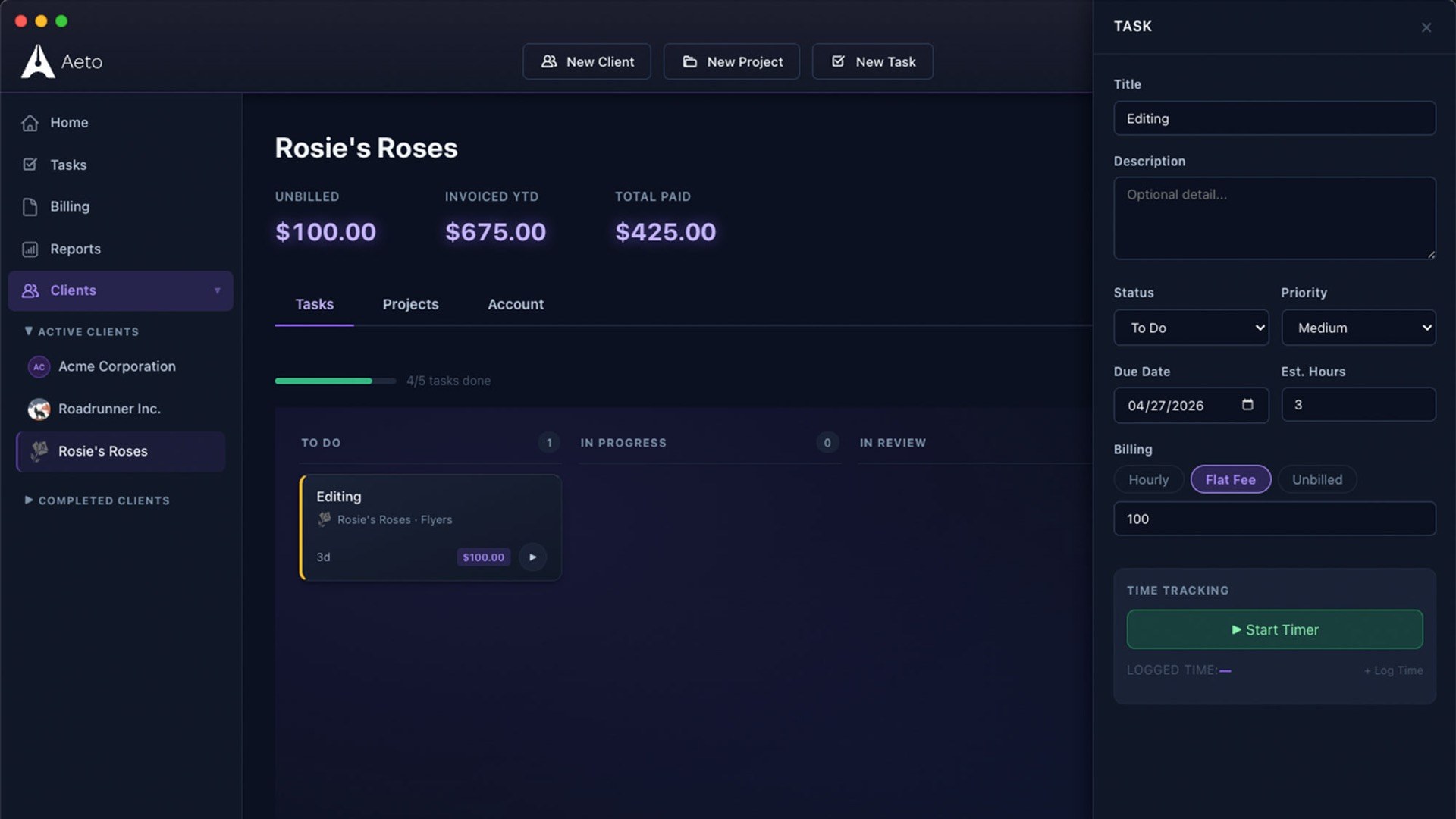
Aeto doesn’t write contracts or proposals, so the revision clause itself lives in whatever agreement you already use.
Try It This Week: The Revision Count
This takes about an hour, and it gives you the number you need before the next quote goes out.
- Pick your last three flat-fee design projects.
- For each one, count how many revision rounds actually happened, and how many your quote included.
- Estimate or pull the hours for every round past the second.
- Multiply those hours by your rate. That’s what the free rounds cost you.
- Use your average hours per round to set a price for an extra round, and add the clause above to your next agreement.
If the total from step 4 surprises you, it’s worth running a full invoice audit next. And if you find that most of your projects already go to three or four rounds, ask yourself whether the clients need more rounds, or whether they just never had a reason to decide sooner.
Start a 30-day free trial. No credit card required.
Frequently Asked Questions
How many revision rounds should a freelance designer include?
Two. The first round reacts to the work, and the second fixes what the first round surfaced. Anything after that is usually new thinking from the client, a new reviewer, or feedback that should have come in round one. Put two in the fee, and quote any round after that as its own line item before you start it.
What counts as one revision round in design work?
One revision round is one consolidated set of written feedback from the named approver on one deliverable, followed by one set of changes from the designer. Feedback that arrives in five separate emails over a week counts as one round only if the client sends it as one list. A request to change the approved direction, such as a new logo concept, is new scope rather than a revision.
How much should a designer charge for an extra revision round?
Charge a fixed price per round based on your own history. Take the average hours your recent revision rounds took, multiply by your hourly rate, and round up. If your rounds average about 4.75 hours and your rate is $120, quote $600 per extra round. Quote it before you start, and don’t discount it, since late rounds usually take longer than early ones.
Should freelance designers offer unlimited revisions?
No. Unlimited revisions remove the reason for a client to consolidate feedback or make a decision, so projects run longer and the designer absorbs the extra hours. A fixed number of included rounds, with a clear price for more, gives the client the same safety net without making your time the cost of their indecision.
How do you tell a client a revision round is extra?
Tell them before you start the work, in writing. A short note works (this will be round three, the agreement covers two, the round is $600, and you’ll start once they confirm). Sending the price first lets the client decide whether the change is worth it, which is a better conversation than an unexpected line on the invoice.